


[Jan 14, 2022] ValidDumps CKA dumps & Kubernetes Administrator sure practice dumps
Linux Foundation CKA Actual Questions and Braindumps
NEW QUESTION 14
A bootstrap USB flash drive has been prepared using a Linux workstation to load the initial configuration of a Palo Alto Networks firewall. The USB flash drive was formatted using file system ntfs and the initial configuration is stored in a file named init-cfg.txt.
The contents of Init-cfg.txt in the USB flash drive are as follows:
type=static
ip-address=10.5.107.19
default-gateway=10.5.107.1
netmask=255.255.255.0
Ipv6-address=2001:400:100::1/64
ipv6-default-gateway=2001:400:100::2
hostname=Ca-FW-DC1
panorama-server=10.5.107.20
panorama-server-2=10.5.107.21
tplname=FINANCE TG4
dgname=finance_dg
dns-primary=10.5.6.6
op-command-modes multi-vsys.jumbo-frame
dhcp-send-hostname=no
dhcp-send-client-id=no
dhcp-accept-server-hostname=no
dhcp-accept-server-domain=no
The USB flash drive has been inserted in the firewalls' USB port, and the firewall has been powered on.Upon boot, the firewall fails to begin the bootstrapping process. The failure is caused because:
- A. The bootstrap.xml file is a required file, but it is missing
- B. The USB drive has been formatted with an unsupported file system
- C. The USB must be formatted using the ext4 file system
- D. nit-cfg bit is an incorrect filename the correct filename should be init-ofg.xml
- E. There must be commas between the parameter names and their values instead of the equal symbols
Answer: C
NEW QUESTION 15
Get list of all pods in all namespaces and write it to file "/opt/pods-list.yaml"
Answer:
Explanation:
kubectl get po -all-namespaces > /opt/pods-list.yaml
NEW QUESTION 16
List all service account and create a service account called "admin"
- A. kubectl get sa
kubectl get sa --all-namespaces
kubectl create sa admin
//Verify
kubectl get sa admin -o yaml - B. kubectl get sa
kubectl get sa --all-namespaces
//Verify
kubectl get sa admin -o yaml
Answer: A
NEW QUESTION 17
Perform the following tasks:
Add an init container to hungry-bear defined in spec file
/opt/KUCC00108/pod-spec-KUC
The init container should create /workdir/calm.txt
If /workdir/calm.txt is not
Once the spec file has been definition, the pod should be created
Answer:
Explanation:
See the solution below.
Explanation
solution
F:\Work\Data Entry Work\Data Entry\20200827\CKA\4 B.JPG
F:\Work\Data Entry Work\Data Entry\20200827\CKA\4 C.JPG
F:\Work\Data Entry Work\Data Entry\20200827\CKA\4 D.JPG
NEW QUESTION 18
Check the history of the specific revision of that deployment
Answer:
Explanation:
kubectl rollout history deploy webapp --revision=3
NEW QUESTION 19
For this item, you will have to ssh to the nodes ik8s-master-0 and ik8s-node-0 and complete all tasks on these nodes. Ensure that you return to the base node (hostname: node-1) when you have completed this item.
Context
As an administrator of a small development team, you have been asked to set up a Kubernetes cluster to test the viability of a new application.
Task
You must use kubeadm to perform this task. Any kubeadm invocations will require the use of the
--ignore-preflight-errors=all option.
* Configure the node ik8s-master-O as a master node. .
* Join the node ik8s-node-o to the cluster.
Answer:
Explanation:
See the solution below.
Explanation
solution
You must use the kubeadm configuration file located at /etc/kubeadm.conf when initializingyour cluster.
You may use any CNI plugin to complete this task, but if you don't have your favourite CNI plugin's manifest URL at hand, Calico is one popular option: https://docs.projectcalico.org/v3.14/manifests/calico.yaml Docker is already installed on both nodes and has been configured so that you can install the required tools.
NEW QUESTION 20
Score: 13%
Task
A Kubernetes worker node, named wk8s-node-0 is in state NotReady. Investigate why this is the case, and perform any appropriate steps to bring the node to a Ready state, ensuring that any changes are made permanent.
Answer:
Explanation:
See the solution below.
Explanation
Solution:
sudo -i
systemctl status kubelet
systemctl start kubelet
systemctl enable kubelet
NEW QUESTION 21
Create an nginx pod and list the pod with different levels of verbosity
- A. // create a pod
kubectl run nginx --image=nginx --restart=Never --port=80
// List the pod with different verbosity
kubectl get po nginx --v=7
kubectl get po nginx --v=6
kubectl get po nginx --v=9 - B. // create a pod
kubectl run nginx --image=nginx --restart=Never --port=80
// List the pod with different verbosity
kubectl get po nginx --v=7
kubectl get po nginx --v=8
kubectl get po nginx --v=9
Answer: B
NEW QUESTION 22
Create a Kubernetes secret as follows:
Name: super-secret
password: bob
Create a pod named pod-secrets-via-file, using the redis Image, which mounts a secret named super-secret at
/secrets.
Create a second pod named pod-secrets-via-env, using the redis Image, which exports password as CONFIDENTIAL
Answer:
Explanation:
See the solution below.
Explanation
solution
F:\Work\Data Entry Work\Data Entry\20200827\CKA\12 B.JPG
F:\Work\Data Entry Work\Data Entry\20200827\CKA\12 C.JPG
F:\Work\Data Entry Work\Data Entry\20200827\CKA\12 D.JPG
NEW QUESTION 23
Get the number of schedulable nodes and write to a file
/opt/schedulable-nodes.txt
- A. kubectl get nodes -o jsonpath="{range
.items[*]}{.metadata.name}
{.spec.taints[?(@.effect=='NoSchedule')].effect}{\"\n\"}{end}"
| awk 'NF==11 {print $0}' > /opt/schedulable-nodes.txt
// Verify
cat /opt/schedulable-nodes.txt - B. kubectl get nodes -o jsonpath="{range
.items[*]}{.metadata.name}
{.spec.taints[?(@.effect=='NoSchedule')].effect}{\"\n\"}{end}"
| awk 'NF==1 {print $0}' > /opt/schedulable-nodes.txt
// Verify
cat /opt/schedulable-nodes.txt
Answer: B
NEW QUESTION 24
A Kubernetes worker node, named wk8s-node-0 is in state NotReady. Investigate why this is the case, and perform any appropriate steps to bring the node to a Ready state, ensuring that any changes are made permanent.
You can ssh to the failed node using:
[student@node-1] $ | ssh Wk8s-node-0
You can assume elevated privileges on the node with the following command:
[student@w8ks-node-0] $ | sudo -i
Answer:
Explanation:
See the solution below.
Explanation
solution


NEW QUESTION 25
Configure the kubelet systemd-managed service, on the nodelabelled withname=wk8s-node-1, tolaunch a pod containing a singlecontainer of Image automatically. Any spec filesrequired should be placed in the/etc/kubernetes/manifests You canssh to theappropriate node using:
[student@node-1] $ sshwk8s-node-1
You can assume elevatedprivileges on the node with thefollowing command:
[student@wk8s-node-1] $ |sudo -i
Answer:
Explanation:
See the solution below.
Explanation
solution


NEW QUESTION 26
Monitor the logs of pod foo and:
* Extract log lines corresponding unable-to-access-website
* Write them to/opt/KULM00201/foo
Answer:
Explanation:
See the solution below.
Explanation
solution

NEW QUESTION 27
Get list of persistent volumes and persistent volume claim in the cluster
Answer:
Explanation:
kubectl get pv kubectl get pvc
NEW QUESTION 28
Perform the following tasks:
* Add an init container tohungry-bear(which has beendefined in spec file
/opt/KUCC00108/pod-spec-KUCC00108.yaml)
* The init container should createan empty file named/workdir/calm.txt
* If/workdir/calm.txtis notdetected, the pod should exit
* Once the spec file has beenupdatedwith the init containerdefinition, the pod should becreated
Answer:
Explanation:
See the solution below.
Explanation
solution


NEW QUESTION 29
Undo the deployment with the previous version and verify
everything is Ok
Answer:
Explanation:
kubectl rollout undo deploy webapp kubectl rollout status deploy webapp kubectl get pods
NEW QUESTION 30
Configure the kubelet systemd- managed service, on the node labelled with name=wk8s-node-1, to launch a pod containing a single container of Image httpd named webtool automatically. Any spec files required should be placed in the /etc/kubernetes/manifests directory on the node.
You can ssh to the appropriate node using:
[student@node-1] $ ssh wk8s-node-1
You can assume elevated privileges on the node with the following command:
[student@wk8s-node-1] $ | sudo -i
Answer:
Explanation:
See the solution below.
Explanation
solution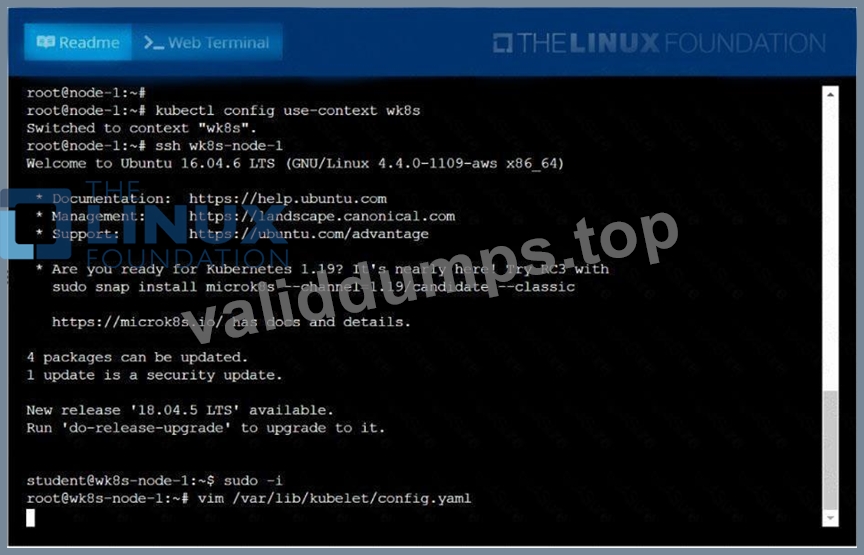


NEW QUESTION 31
Create 2 nginx image pods in which one of them is labelled with env=prod and another one labelled with env=dev and verify the same.
Answer:
Explanation:
See the solution below.
Explanation
kubectl run --generator=run-pod/v1 --image=nginx -- labels=env=prod nginx-prod --dry-run -o yaml > nginx-prodpod.yaml Now, edit nginx-prod-pod.yaml file and remove entries like "creationTimestamp: null"
"dnsPolicy: ClusterFirst"
vim nginx-prod-pod.yaml
apiVersion: v1
kind: Pod
metadata:
labels:
env: prod
name: nginx-prod
spec:
containers:
- image: nginx
name: nginx-prod
restartPolicy: Always
# kubectl create -f nginx-prod-pod.yaml
kubectl run --generator=run-pod/v1 --image=nginx --
labels=env=dev nginx-dev --dry-run -o yaml > nginx-dev-pod.yaml
apiVersion: v1
kind: Pod
metadata:
labels:
env: dev
name: nginx-dev
spec:
containers:
- image: nginx
name: nginx-dev
restartPolicy: Always
# kubectl create -f nginx-prod-dev.yaml
Verify :
kubectl get po --show-labels
kubectl get po -l env=prod
kubectl get po -l env=dev
NEW QUESTION 32
Create a pod that echo "hello world" and then exists. Have the pod deleted automatically when it's completed
Answer:
Explanation:
See the solution below.
Explanation
kubectl run busybox --image=busybox -it --rm --restart=Never --
/bin/sh -c 'echo hello world'
kubectl get po # You shouldn't see pod with the name "busybox"
NEW QUESTION 33
What is the maximum number of samples that can be submitted to WildFire manually per day?
- A. 1,000
- B. 5,000
- C. 2,000
- D. 15,000
Answer: A
NEW QUESTION 34
Perform the following tasks:
* Add an init container to hungry-bear (which has been defined in spec file
/opt/KUCC00108/pod-spec-KUCC00108.yaml)
* The init container should create an empty file named/workdir/calm.txt
* If /workdir/calm.txt is not detected, the pod should exit
Answer:
Explanation:
* Once the spec file has been updated with the init container definition, the pod should be created See the solution below.
Explanation
solution


NEW QUESTION 35
......
Who should take the Linux Foundation-CKA: Certified Kubernetes Administrator Exam
This certification will allow the candidate to be setup as a succesfull Kubernetes Administrator and will be able to know and work on the following things:
- Kubernetes logging and monitoring
- Kubernetes storage
- Kubernetes cluster maintenance
- Kubernetes scheduling
- Kubernetes security
- Kubernetes core operations concepts
- Kubernetes installation, configuration, and validation
- Troubleshooting Kubernetes
- Kubernetes networking
- Kubernetes and application Lifecycle Management
Introduction to Linux Foundation-CKA: Certified Kubernetes Administrator Exam
The CKA tests your ability to deploy and configure a Kubernetes cluster as well as your understanding of core concepts.
They can do any of the following without assistance:
- Core concepts
- Networking
- Troubleshooting
- Application lifecycle management
- Logging/monitoring
- Installation, configuration & validatio
- Cluster maintenance
- Storage
- Scheduling
- Security
Latest CKA Pass Guaranteed Exam Dumps with Accurate & Updated Questions: https://www.validdumps.top/CKA-exam-torrent.html
Pass CKA Exam with Updated CKA Exam Dumps PDF 2022: https://drive.google.com/open?id=1Xdv11UfAgdAlhd7Aq1PkgQojSlIF0Nlc