


[Nov 08, 2023] Free JNCIP-ENT JN0-649 Official Cert Guide PDF Download
Juniper JN0-649 Official Cert Guide PDF
Juniper JN0-649 exam is a professional-level certification exam that is designed to test the candidate's knowledge and skills in enterprise routing and switching. JN0-649 exam is intended for individuals who have a strong understanding of networking technologies and protocols and are looking to advance their careers in the field of enterprise networking. The JN0-649 exam covers a wide range of topics, including advanced routing protocols, network virtualization, Layer 2 and Layer 3 switching, and security protocols.
The JN0-649 certification exam is an excellent opportunity for network engineers and administrators to demonstrate their skills and knowledge in enterprise routing and switching. It is a challenging exam that requires candidates to have a strong understanding of the Juniper Networks technologies and the ability to apply that knowledge to real-world scenarios. Passing the JN0-649 exam can help individuals advance their careers and demonstrate their expertise to employers and peers.
NEW QUESTION # 35
Click the Exhibit.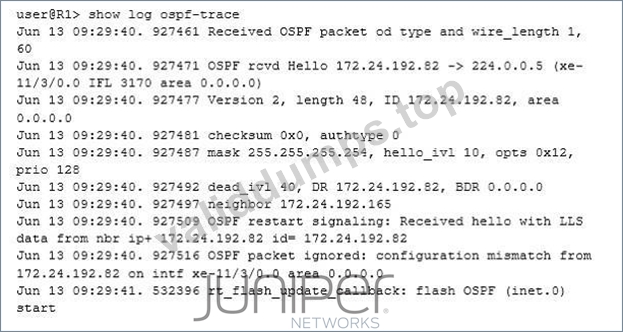
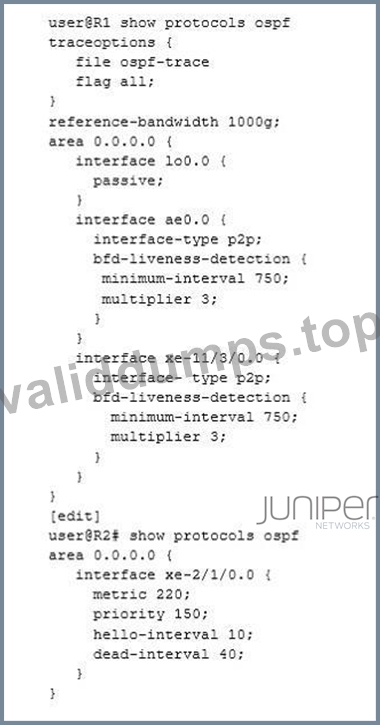
You have just configured on an OSPF adjacency between two routers. After you commit the configuration, you notice that your adjacency is not up.
Referring to the exhibit, what would cause the problem?
- A. You must configure bfd on R2.
- B. You must configure hello and dead intervals on R1.
- C. You must configure on interface-type o n R2.
- D. You must configure lo on R2.
Answer: C
NEW QUESTION # 36
What are three well-known mandatory BGP attributes? (Choose three.)
- A. MED
- B. community
- C. origin
- D. next-hop
- E. AS-path
Answer: C,D,E
NEW QUESTION # 37
A Layer 2 connection does not expend across data centers. The IP subnet in a Layer 2 domain is confined within a single data center.
Which EVPN route type is used to communicate prefixes between the data centers?
- A. Type 4
- B. Type 1
- C. Type 5
- D. Type 2
Answer: C
Explanation:
https://www.juniper.net/documentation/us/en/software/junos/evpn-vxlan/topics/concept/evpn-route-type5-understanding.html#:~:text=In%20the%20control%20plane%2C%20EVPN,subnet%20connectivity%20across%20data%20centers.
NEW QUESTION # 38
You must provide network connectivity to hosts that fail authentication.
In this scenario, what would be used in a network secured with 802.1X to satisfy this requirement?
- A. Configure a secondary IP address on the port for unauthenticated hosts.
- B. Use the server-reject-vlan command to specify a guest VLAN.
- C. Configure the native-vlan-id parameter on the port.
- D. Configure the port as a spanning tree edge port.
Answer: B
Explanation:
For a device configured for 802.1X authentication, specify that when the device receives an Extensible Authentication Protocol Over LAN (EAPoL) Access-Reject message during the authentication process between the device and the RADIUS authentication server, supplicants attempting to access the LAN are granted access and moved to a specific bridge domain or VLAN. Any bridge domain, VLAN name or VLAN ID sent by a RADIUS server as part of the EAPoL Access-Reject message is ignored.
NEW QUESTION # 39
When using wide metrics, which two statements about route advertisement between IS-IS levels are correct? (Choose two.)
- A. Level 1 routes advertised as external routes into Level 1 are not advertised to any Level 2 routers by default.
- B. Level 1 and Level 2 routers do not advertise Level 2 routes into the Level 1 area by default.
- C. Level 1 routes are advertised to Level 2 routers by default.
- D. If wide-metrics-only is configured, Level 1 routes are not advertised to Level 2 routers by default.
Answer: B,D
NEW QUESTION # 40
You want to create an OSPF area that only contains intra-area route information in the form of Type 1 and Type 2 LSAs.
In this scenario, which area is needed to accomplish this task?
- A. non-to-stubby area
- B. stub area
- C. totally stubby area
- D. totally non-to-stubby area
Answer: C
NEW QUESTION # 41
Referring to the exhibit, anycast RP is implemented to ensure multicast service availability. The source is currently sending multicast traffic using group 239.1.1.1 and R3 is receiving PIM register messages, but R2 does not have active source information.
In this scenario, what are two methods to receive the active source information on R2? (Choose two.)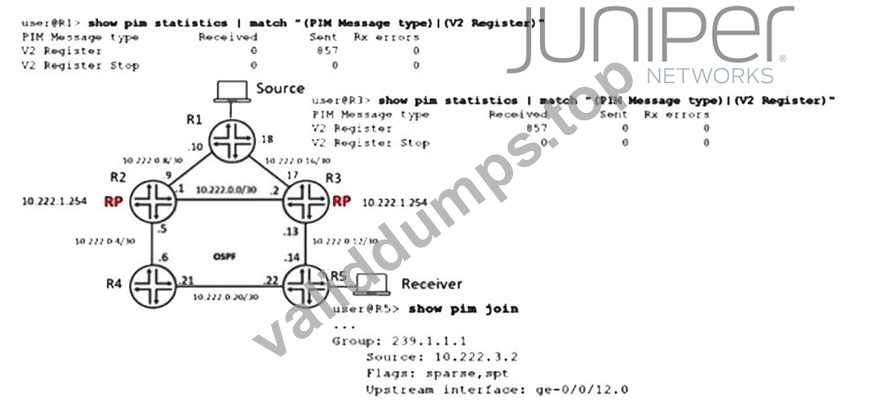
- A. Configure an RP set in PIM on R1, allowing R1 to forward PIM register messages to R2 and R3 in the set.
- B. Configure an RP set in PIM on R2 and R3, allowing the RPs to forward PIM register messages to the other RPs in the set.
- C. Configure an MSDP protocol between R2 and R3.
- D. Configure an MSDP protocol between R1 and R2.
Answer: A,B
Explanation:
https://www.juniper.net/documentation/us/en/software/junos/multicast/topics/ref/statement/rp-set-edit-protocols-pim.html
NEW QUESTION # 42
You have scheduled maintenance operations for one of the devices in your OSPF network.
Referring to the exhibit, which three statements are correct? (Choose three.)
- A. Any traffic destined for networks that terminate on R1 will still be forwarded to R1.
- B. R1 does not send or receive transit traffic during the maintenance window even if no alternative paths exist to the given destination.
- C. The metrics for all transit interfaces on R1 is set to the maximum value of 65,535.
- D. R1 does not participate in OSPF routing.
- E. R1 participates in OSPF routing but does not send or receive transit traffic.
Answer: A,C,E
NEW QUESTION # 43
What information must you gather from the satellite device to provision a Junos Fusion Enterprise deployment on the aggregation device? (Choose two.)
- A. Software version
- B. Serial number
- C. Model number
- D. MAC address
Answer: B,D
NEW QUESTION # 44
You configured static mode power management on an EX4300 to provide PoE power to telephone and access point equipment.
Which statement is correct regarding the PoE power budget?
- A. Power is budgeted to devices on a first come, first served basis as devices are connected.
- B. The power budgeted will be based on the device class connected to each port.
- C. The power budgeted to ports will adjust to how much power a device actually uses.
- D. Power is budgeted to a port even if no device is connected to the port.
Answer: D
NEW QUESTION # 45
Referring to the exhibit, which statement is correct when a failure exists on the link between host2 and switch5 on this EVPN-VXLAN fabric?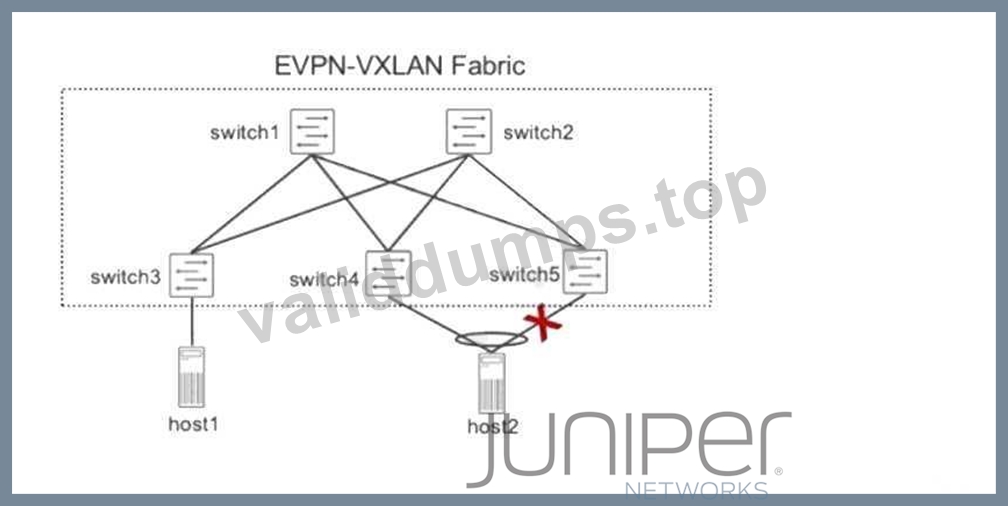
- A. The switch5 device will send a Type 4 route to all peers.
- B. The switch5 device will send a Type 1 route to all peers.
- C. The switch5 device will send a Type 2 route to all peers.
- D. The switch5 device will send a Type 3 route to all peers.
Answer: D
NEW QUESTION # 46
Referring to the exhibit, which TTL value will be sent to the LLDP neighbors?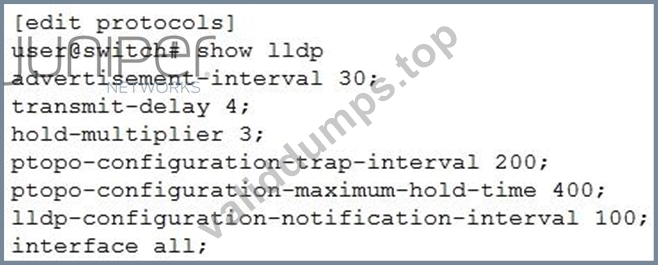
- A. 200 seconds
- B. 120 seconds
- C. 400 seconds
- D. 90 seconds
Answer: B
NEW QUESTION # 47
Which two statements are true regarding bidirectional PIM? (Choose two )
- A. Devices only store group specific entries.
- B. It uses multicast tunneling to forward traffic
- C. Forwarding paths can be suboptimal
- D. It eliminates the need for an RP.
Answer: A,C
NEW QUESTION # 48
Which BGP message type contains NLRI information?
- A. open
- B. update
- C. notification
- D. keepalive
Answer: B
NEW QUESTION # 49
You are asked to enforce user authentication using a captive portal before users access the corporate network.
Which statement is correct in this scenario?
- A. All Web browser requests are redirected to the captive portal until authentication is successful.
- B. A captive portal can be bypassed using an allowlist command containing a device's IP address.
- C. HTTPS is the default protocol for a captive portal.
- D. When enabled, a captive portal must be applied to each individual interface.
Answer: A
Explanation:
You can set up captive portal authentication on your switch to redirect all Web browser requests to a login page that requires users to input a username and password before they are allowed access. Upon successful authentication, users are allowed access to the network and redirected to the original page requested. Junos OS provides a customizable template for the captive portal window that allows you to easily design and modify the look of the captive portal login page. You can modify the design elements of the template to change the look of your captive portal login page and to add instructions or information to the page. You can also modify any of the design elements of a captive portal login page. The first screen displayed before the captive login page requires the user to read the terms and conditions of use. By clicking the Agree button, the user can access the captive portal login page. https://www.juniper.net/documentation/us/en/software/junos/user-access/topics/topic-map/user-authentication-captive-portal.html
NEW QUESTION # 50
Referring to the exhibit, which statement is correct?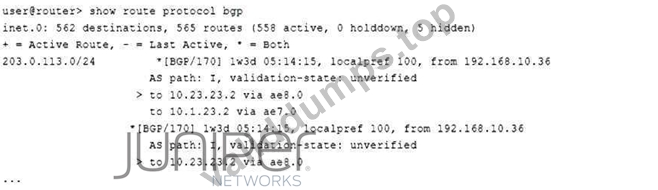
- A. The route is learned from a multipath BGP session.
- B. The route is learned from three different neighbors.
- C. The route is learned from only one neighbor.
- D. The route is learned from a multihop BGP session.
Answer: C
NEW QUESTION # 51
There are two BGP routes to 10.200.200.0/24 received from two external peers. Route 1 comes from a neighbor with a router ID of 10.10.100.1 and a peer IP address of 10.10.30.1, and route 2 comes from a neighbor with a router ID of 10.10.200.1 and a peer IP address of 10.10.50.1. Both routes have the same MED value, origin value, AS path length, and local preference number.
In this scenario, which statement is correct about the active route?
- A. Route 2 will be active because of the router ID.
- B. Route 1 will be active because of the router ID.
- C. Route 1 will be active because of the peer IP address.
- D. Route 2 will be active because of the peer IP address.
Answer: B
Explanation:
The router determines the router ID for each peer that advertised a path to the route destination. A lower router ID value is preferred over a higher router ID value. 10. The router determines the peer ID for each peer that advertised a path to the router destination. A lower peer ID value is preferred over a higher peer ID value. The peer ID is the IP address of the established BGP peering session.
NEW QUESTION # 52
A user is attempting to watch a high-definition video being streamed from the media server over the network. However, the user complains that the experienced video quality is poor. While logged on to router B, a Juniper Networks device, you notice that video packets are being dropped.
In this scenario, what would solve this problem?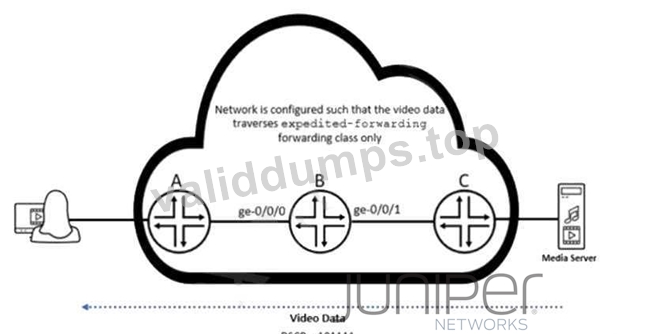
- A. Adjust the scheduler for the expedited-forwarding forwarding class to support a higher transmit rate.
- B. Adjust the scheduler-map to support a higher transmit rate.
- C. Adjust the expedited-forwarding BA classifier to router B's ge-0/0/0 interface to support a higher transmit rate.
- D. Adjust the expedited-forwarding BA classifier on router B's ge-0/0/1 interface to support a higher transmit rate.
Answer: D
NEW QUESTION # 53
Referring to the exhibit, you configured a new multicast classifier for the ge-1/2/0 interface ICMP traffic to the best-effort queue and traffic from 190.168.20.0/24 to the expedited forwarding queue.
You received noticed that some application are not working after the change.
Which configuration change will remedy the problem?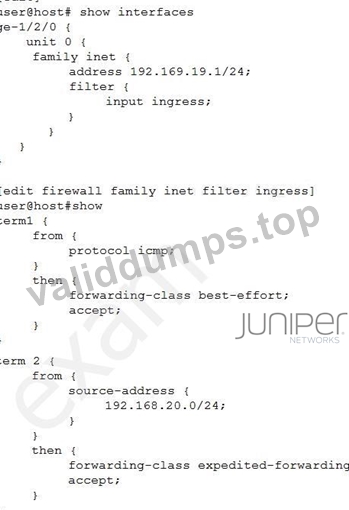
- A. [edit firewall family inet filter ingress
User@host # set term 2 from protocol tcp - B. [edit firewall family inet filter ingress
User@host # set term 3 then next - C. [edit firewall family inet filter ingress
User@host # set term 2 from service-filter hit - D. [edit firewall family inet filter ingress
User@host # set term 3 then accept
Answer: D
NEW QUESTION # 54
You are asked to configure an 802.1X solution that supports dynamic VLAN assignment. In this scenario, which two modes support using vendor-specific attributes (VSAs)? (Choose two.)
- A. single-secure supplicant mode
- B. static MAC bypass mode
- C. multiple supplicant mode
- D. single supplicant mode
Answer: A,C
NEW QUESTION # 55
You are using 802.1X authentication in your network to secure all ports. You have a printer that does not support 802.1X and you must ensure that traffic is allowed to and from this printer without authentication.
In this scenario, what will satisfy the requirement?
- A. static MAC bypass
- B. MACsec
- C. MAC filtering
- D. MAC RADIUS
Answer: A
Explanation:
https://www.juniper.net/documentation/us/en/software/junos/user-access/topics/topic-map/static-mac-bypass-mac-radius-authentication.html
NEW QUESTION # 56
Packets enter a Juniper device and are classified as best effort. During the processing of the packet, the classification of the packets is changed to expedited forwarding by a multi-field classifier. The device is using the default CoS policies Which statement is true in this scenario?
- A. The packet is forwarded according to the new packet classification, and the DSCP bits are rewritten to the new class.
- B. The packet is forwarded according to the new packet classification, and the DSCP bits do not change.
- C. The packet is forwarded according to the original packet classification, and the DSCP bits do not change.
- D. The packet is forwarded according to the original packet classification, and the DSCP bits are rewritten to the new class.
Answer: B
NEW QUESTION # 57
You are asked to enforce user authentication using a captive portal before users access the corporate network.
Which statement is correct in this scenario?
- A. All Web browser requests are redirected to the captive portal until authentication is successful.
- B. A captive portal can be bypassed using an allowlist command containing a device's IP address.
- C. HTTPS is the default protocol for a captive portal.
- D. When enabled, a captive portal must be applied to each individual interface.
Answer: A
NEW QUESTION # 58
......
The JN0-649 certification exam is a vendor-specific exam offered by Juniper Networks, a leading networking solutions provider. JN0-649 exam is designed to test candidates on their understanding of Juniper Networks’ enterprise routing and switching technologies, including the Junos operating system, virtual private networks (VPNs), and multicast protocols. Passing the JN0-649 exam validates that a candidate has the necessary knowledge and skills to design, implement, and manage complex enterprise-level networks using Juniper Networks’ technologies.
Free JN0-649 Exam Dumps to Improve Exam Score: https://www.validdumps.top/JN0-649-exam-torrent.html
Exam JN0-649: New Brain Dump Professional - ValidDumps: https://drive.google.com/open?id=1e6yvWt69LfxebRaQ-wgQ2mjfXkYD2X-W