


Pass Your Associate-Cloud-Engineer Dumps as PDF Updated on 2023 With 218 Questions
Google Associate-Cloud-Engineer Real Exam Questions and Answers FREE
Below are the requirements of Associate Cloud Engineer Exam
There is no prerequisite for Oracle Associate Cloud Engineer certification.
Below are the topics of Associate Cloud Engineer Exam
Candidates must know the exam topics before they start of preparation. Because it will really help them in hitting the core. Our Associate Cloud Engineer exam dumps will include the following topics:
- Ensuring successful operation of a cloud solution
- Setting up a cloud solution environment
- Deploying and implementing a cloud solution
- Configuring access and security
- Planning and configuring a cloud solution
NEW QUESTION 26
You need to provide a cost estimate for a Kubernetes cluster using the GCP pricing calculator for Kubernetes. Your workload requires high IOPs, and you will also be using disk snapshots. You start by entering the number of nodes, average hours, and average days. What should you do next?
- A. Select Add GPUs. Fill in persistent disk storage and snapshot storage.
- B. Fill in local SSD. Fill in persistent disk storage and snapshot storage.
- C. Fill in local SSD. Add estimated cost for cluster management.
- D. Select Add GPUs. Add estimated cost for cluster management.
Answer: A
Explanation:
Reference:
https://cloud.google.com/products/calculator#tab=container
NEW QUESTION 27
You need to host an application on a Compute Engine instance in a project shared with other teams. You want to prevent the other teams from accidentally causing downtime on that application. Which feature should you use?
- A. Use a Preemptible VM.
- B. Use a Shielded VM.
- C. Use a sole-tenant node.
- D. Enable deletion protection on the instance.
Answer: D
Explanation:
Preventing Accidental VM Deletion
This document describes how to protect specific VM instances from deletion by setting the deletionProtection property on an Instance resource. To learn more about VM instances, read the Instances documentation.
As part of your workload, there might be certain VM instances that are critical to running your application or services, such as an instance running a SQL server, a server used as a license manager, and so on. These VM instances might need to stay running indefinitely so you need a way to protect these VMs from being deleted.
By setting the deletionProtection flag, a VM instance can be protected from accidental deletion. If a user attempts to delete a VM instance for which you have set the deletionProtection flag, the request fails. Only a user that has been granted a role with compute.instances.create permission can reset the flag to allow the resource to be deleted.
https://cloud.google.com/compute/docs/instances/preventing-accidental-vm-deletion
NEW QUESTION 28
You need to create a Compute Engine instance in a new project that doesn't exist yet. What should you do?
- A. Using the Cloud SDK, create a new project, enable the Compute Engine API in that project, and then create the instance specifying your new project.
- B. Using the Cloud SDK, create the new instance, and use the -pproject flag to specify the new project.
Answer yes when prompted by Cloud SDK to enable the Compute Engine API. - C. Enable the Compute Engine API in the Cloud Console, use the Cloud SDK to create the instance, and then use the -pproject flag to specify a new project.
- D. Enable the Compute Engine API in the Cloud Console. Go to the Compute Engine section of the Console to create a new instance, and look for the Create In A New Project option in the creation form.
Answer: C
NEW QUESTION 29
You have been asked to build backend using Clojure and host it on Google Cloud with full freedom of choosing OS, applications, libraries, etc. Which service will you prefer?
- A. Cloud Function
- B. App Engine Standard
- C. CloudRun
- D. Compute Engine
Answer: D
NEW QUESTION 30
You've uploaded some PDFs to a public bucket. When users browse to the documents, they're downloaded rather than viewed in the browser. How can we ensure that the PDFs are viewed in the browser?
- A. Set the Content metadata for the object to "application/pdf".
- B. This is a browser setting and not something that can be changed.
- C. Set the Content-Type metadata for the object to "application/pdf".
- D. Use the gsutil set file-type pdfcommand.
Answer: C
NEW QUESTION 31
An application requires block storage for file updates. The data is 500 GB and must continuously sustain 100 MiB/s of aggregate read/write operations.
Which storage option is appropriate for this application?
- A. Amazon EFS
- B. Amazon Glacier
- C. Amazon EBS
- D. Amazon S3
Answer: C
NEW QUESTION 32
You are building a pipeline to process time-series data.
Which Google Cloud Platform services should you put in boxes 1,2,3, and 4?
- A. Cloud Pub/Sub, Cloud Dataflow, Cloud Datastore, BigQuery
- B. Cloud Pub/Sub, Cloud Storage, BigQuery, Cloud Bigtable
- C. Cloud Pub/Sub, Cloud Dataflow, Cloud Bigtable, BigQuery
- D. Firebase Messages, Cloud Pub/Sub, Cloud Spanner, BigQuery
Answer: C
NEW QUESTION 33
You are running a data warehouse on BigQuery. A partner company is offering a recommendation engine based on the data in your data warehouse. The partner company is also running their application on Google Cloud. They manage the resources in their own project, but they need access to the BigQuery dataset in your project. You want to provide the partner company with access to the dataset. What should you do?
- A. Create a Service Account in your own project, and grant this Service Account access to BigQuery in your project.
- B. Create a Service Account in your own project, and ask the partner to grant this Service Account access to BigQuery in their project.
- C. Ask the partner to create a Service Account in their project, and grant their Service Account access to the BigQuery dataset in your project.
- D. Ask the partner to create a Service Account in their project, and have them give the Service Account access to BigQuery in their project.
Answer: C
NEW QUESTION 34
Your company has a 3-tier solution running on Compute Engine. The configuration of the current infrastructure is shown below.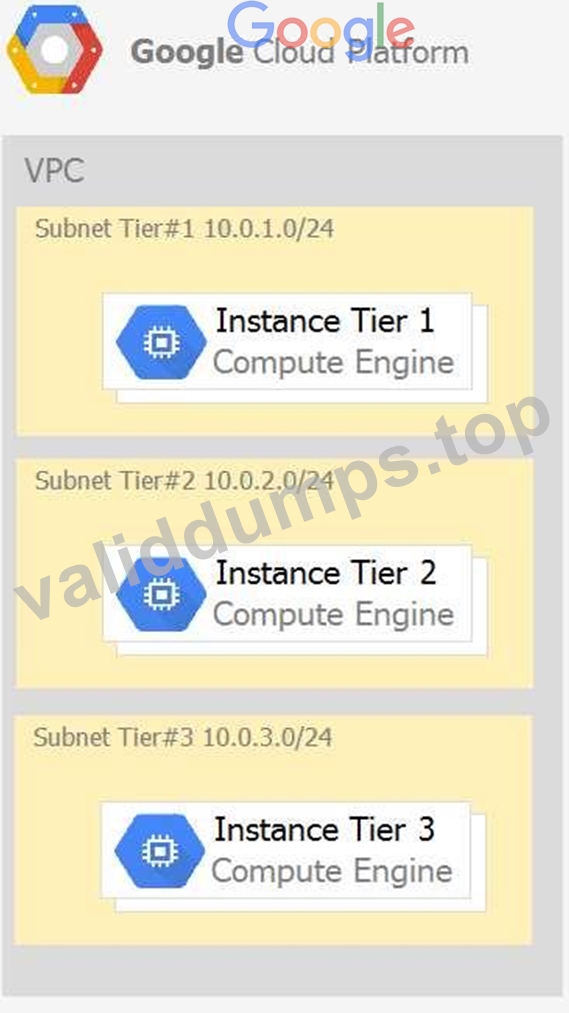
Each tier has a service account that is associated with all instances within it. You need to enable communication on TCP port 8080 between tiers as follows:
* Instances in tier #1 must communicate with tier #2.
* Instances in tier #2 must communicate with tier #3.
What should you do?
- A. 1. Create an ingress firewall rule with the following settings:
* Targets: all instances with tier #2 service account
* Source filter: all instances with tier #1 service account
* Protocols: allow TCP:8080
2. Create an ingress firewall rule with the following settings:
* Targets: all instances with tier #3 service account
* Source filter: all instances with tier #2 service account
* Protocols: allow TCP: 8080 - B. 1. Create an ingress firewall rule with the following settings:
* Targets: all instances with tier #2 service account
* Source filter: all instances with tier #1 service account
* Protocols: allow all
2. Create an ingress firewall rule with the following settings:
* Targets: all instances with tier #3 service account
* Source filter: all instances with tier #2 service account
* Protocols: allow all - C. 1. Create an ingress firewall rule with the following settings:
* Targets: all instances
* Source filter: IP ranges (with the range set to 10.0.2.0/24)
* Protocols: allow all
2. Create an ingress firewall rule with the following settings:
* Targets: all instances
* Source filter: IP ranges (with the range set to 10.0.1.0/24)
* Protocols: allow all - D. 1. Create an egress firewall rule with the following settings:
* Targets: all instances
* Source filter: IP ranges (with the range set to 10.0.2.0/24)
* Protocols: allow TCP: 8080
2. Create an egress firewall rule with the following settings:
* Targets: all instances
* Source filter: IP ranges (with the range set to 10.0.1.0/24)
* Protocols: allow TCP: 8080
Answer: A
NEW QUESTION 35
You are storing sensitive information in a Cloud Storage bucket. For legal reasons, you need to be able to record all requests that read any of the stored data. You want to make sure you comply with these requirements. What should you do?
- A. Scan the bucker using the Data Loss Prevention API.
- B. Enable Data Access audit logs for the Cloud Storage API.
- C. Allow only a single Service Account access to read the data.
- D. Enable the Identity Aware Proxy API on the project.
Answer: B
Explanation:
https://cloud.google.com/storage/docs/audit-logs
NEW QUESTION 36
You need to immediately change the storage class of an existing Google Cloud bucket.
You need to reduce service cost for infrequently accessed files stored in that bucket and for all files that will be added to that bucket in the future. What should you do?
- A. Create a new bucket and change the default storage class for the bucket import the files from the previous bucket into the new bucket
- B. Use the gsutil to rewrite the storage class for the bucket.
Set up Object Lifecycle management on the bucket - C. Create a new bucket and change the default storage class for the bucket.
Set up Object Lifecycle management on lite bucket - D. Use the gsutil to rewrite the storage class for the bucket.
Change the default storage class for the bucket
Answer: B
NEW QUESTION 37
What conditions could cause a Multi-AZ Amazon RDS failover to occur? (Choose two.)
- A. A failure of the primary database instance
- B. Another master user is created
- C. An Availability Zone becomes unavailable
- D. The RDS instance is stopped manually
- E. A replica of the RDS instance is created in a different region
Answer: A,C
Explanation:
Explanation/Reference:
Reference https://aws.amazon.com/rds/faqs/
NEW QUESTION 38
Which of the following is a valid use case for using a primitive role?
- A. When granting permission to a development project or to the development team.
- B. When granting permission to a production project, or to a third-party company.
- C. When creating a custom role requires more than 10 permissions.
- D. When there are more than 10 users.
Answer: A
NEW QUESTION 39
Your company runs its Linux workloads on Compute Engine instances. Your company will be working with a new operations partner that does not use Google Accounts. You need to grant access to the instances to your operations partner so they can maintain the installed tooling. What should you do?
- A. Tag all the instances with the same network tag. Create a firewall rule in the VPC to grant TCP access on port 22 for traffic from the operations partner to instances with the network tag.
- B. Enable Cloud IAP for the Compute Engine instances, and add the operations partner as a Cloud IAP Tunnel User.
- C. Ask the operations partner to generate SSH key pairs, and add the public keys to the VM instances.
- D. Set up Cloud VPN between your Google Cloud VPC and the internal network of the operations partner.
Answer: A
Explanation:
Explanation/Reference: https://cloud.google.com/vpc/docs/firewalls
NEW QUESTION 40
You are running an application on multiple virtual machines within a managed instance group and have autoscaling enabled. The autoscaling policy is configured so that additional instances are added to the group if the CPU utilization of instances goes above 80%. VMs are added until the instance group reaches its maximum limit of five VMs or until CPU utilization of instances lowers to 80%. The initial delay for HTTP health checks against the instances is set to 30 seconds. The virtual machine instances take around three minutes to become available for users. You observe that when the instance group autoscales, it adds more instances then necessary to support the levels of end-user traffic. You want to properly maintain instance group sizes when autoscaling.
What should you do?
- A. Set the maximum number of instances to 1.
- B. Use a TCP health check instead of an HTTP health check.
- C. Increase the initial delay of the HTTP health check to 200 seconds.
- D. Decrease the maximum number of instances to 3.
Answer: C
Explanation:
The virtual machine instances take around three minutes to become available for users.
NEW QUESTION 41
You're working as a Cloud Engineer for a small company. The lead developer needs to create some new projects in order to get started with deploying the codebase. She tried to create a project and received an error. She messaged you on Slack to ask for help, though, she couldn't recall the exact error message. You checked and found that she does have Project Creator permissions. Keeping in mind the principle of least privilege, what is the best role to grant her so that she can create billable projects?
- A. The "Project Owner" role.
- B. The "Billing Account Viewer" role.
- C. The "Billing Account Administrator" role.
- D. The "Billing Account User" role.
Answer: D
NEW QUESTION 42
You are building an application that will run in your data center. The application will use Google Cloud Platform (GCP) services like AutoML. You created a service account that has appropriate access to AutoML. You need to enable authentication to the APIs from your on-premises environment. What should you do?
- A. Use gcloud to create a key file for the service account that has appropriate permissions.
- B. Use service account credentials in your on-premises application.
- C. Go to the IAM & admin console, grant a user account permissions similar to the service account permissions, and use this user account for authentication from your data center.
- D. Set up direct interconnect between your data center and Google Cloud Platform to enable authentication for your on-premises applications.
Answer: A
Explanation:
https://cloud.google.com/vision/automl/docs/before-you-begin
NEW QUESTION 43
You have an application that uses Cloud Spanner as a database backend to keep current state information about users. Cloud Bigtable logs all events triggered by users. You export Cloud Spanner data to Cloud Storage during daily backups. One of your analysts asks you to join data from Cloud Spanner and Cloud Bigtable for specific users. You want to complete this ad hoc request as efficiently as possible. What should you do?
- A. Create a dataflow job that copies data from Cloud Bigtable and Cloud Storage for specific users.
- B. Create a dataflow job that copies data from Cloud Bigtable and Cloud Spanner for specific users.
- C. Create a Cloud Dataproc cluster that runs a Spark job to extract data from Cloud Bigtable and Cloud Storage for specific users.
- D. Create two separate BigQuery external tables on Cloud Storage and Cloud Bigtable.
Use the BigQuery console to join these tables through user fields, and apply appropriate filters.
Answer: B
NEW QUESTION 44
Your team uses a third-party monitoring solution. They've asked you to deploy it to the nodes in your Kubernetes Engine Cluster. What's the best way to do that?
- A. Use Deployment Manager to deploy the monitoring solution.
- B. Deploy the monitoring pod as a DaemonSet.
- C. Connect to each node via SSH and install the monitoring solution.
- D. Deploy the monitoring pod as a Deployment.
Answer: B
NEW QUESTION 45
Your company has a single sign-on (SSO) identity provider that supports Security Assertion Markup Language (SAML) integration with service providers. Your company has users in Cloud Identity. You would like users to authenticate using your company's SSO provider. What should you do?
- A. In Cloud Identity, set up SSO with Google as an identity provider to access custom SAML apps.
- B. Obtain OAuth 2.0 credentials, configure the user consent screen, and set up OAuth 2.0 for Mobile & Desktop Apps.
- C. Obtain OAuth 2.0 credentials, configure the user consent screen, and set up OAuth 2.0 for Web Server Applications.
- D. In Cloud Identity, set up SSO with a third-party identity provider with Google as a service provider.
Answer: B
NEW QUESTION 46
You have been asked to migrate a docker application from datacenter to cloud. Your solution architect has suggested uploading docker images to GCR in one project and running an application in a GKE cluster in a separate project. You want to store images in the project img-278322 and run the application in the project prod-278986. You want to tag the image as acme_track_n_trace:v1. You want to follow Google-recommended practices. What should you do?
- A. Run gcloud builds submit --tag gcr.io/img-278322/acme_track_n_trace:v1
- B. Run gcloud builds submit --tag gcr.io/prod-278986/acme_track_n_trace
- C. Run gcloud builds submit --tag gcr.io/prod-278986/acme_track_n_trace:v1
- D. Run gcloud builds submit --tag gcr.io/img-278322/acme_track_n_trace
Answer: A
Explanation:
Explanation
Run gcloud builds submit tag gcr.io/img-278322/acme_track_n_trace:v1. is the right answer.
This command correctly tags the image as acme_track_n_trace:v1 and uploads the image to the img-278322 project.
Ref: https://cloud.google.com/sdk/gcloud/reference/builds/submit
NEW QUESTION 47
You create a new Google Kubernetes Engine (GKE) cluster and want to make sure that it always runs a supported and stable version of Kubernetes. What should you do?
- A. Select the latest available cluster version for your GKE cluster.
- B. Select "Container-Optimized OS (cos)" as a node image for your GKE cluster.
- C. Enable the Node Auto-Upgrades feature for your GKE cluster.
- D. Enable the Node Auto-Repair feature for your GKE cluster.
Answer: C
NEW QUESTION 48
......
Pass Google Associate-Cloud-Engineer Exam Info and Free Practice Test: https://www.validdumps.top/Associate-Cloud-Engineer-exam-torrent.html
New 2023 Latest Questions Associate-Cloud-Engineer Dumps - Use Updated Google Exam: https://drive.google.com/open?id=1DsjLPBLznPUMfoDq9x91Cz0Fs47PN6j6